










Learn how to release tension and find effortless timing in your swing
– October 22, 2025 | Text Scott Cranfield

We have all had those days when we feel that our timing is just right, our swing feels effortless, there is a lovely flow and our confidence grows. Unfortunately, and probably far too often, we experience the opposite where we are tense, our swing feels constricted and awkward often leading to anxiety and a lack of confidence.
In this article I will show you a simple way to reduce the tension in your swing so that you can have good timing on a consistent basis. And stick around to the end for a bonus.
Moving well, with good timing, means we are moving through the joints of our body in a nice sequential way using each area of our body just the right amount.
All your joints play role from your feet (you have 33 joints in each foot) through your ankles, knees, hips, spine, shoulder, elbow, wrists, etc. When we have too much tension in our body, we tend to start moving as a block, which causes some parts of our body to overwork and other areas to under-work.
When we move like this, good timing is difficult to find – plus it generally does not feel nice – leading to a lack of confidence.

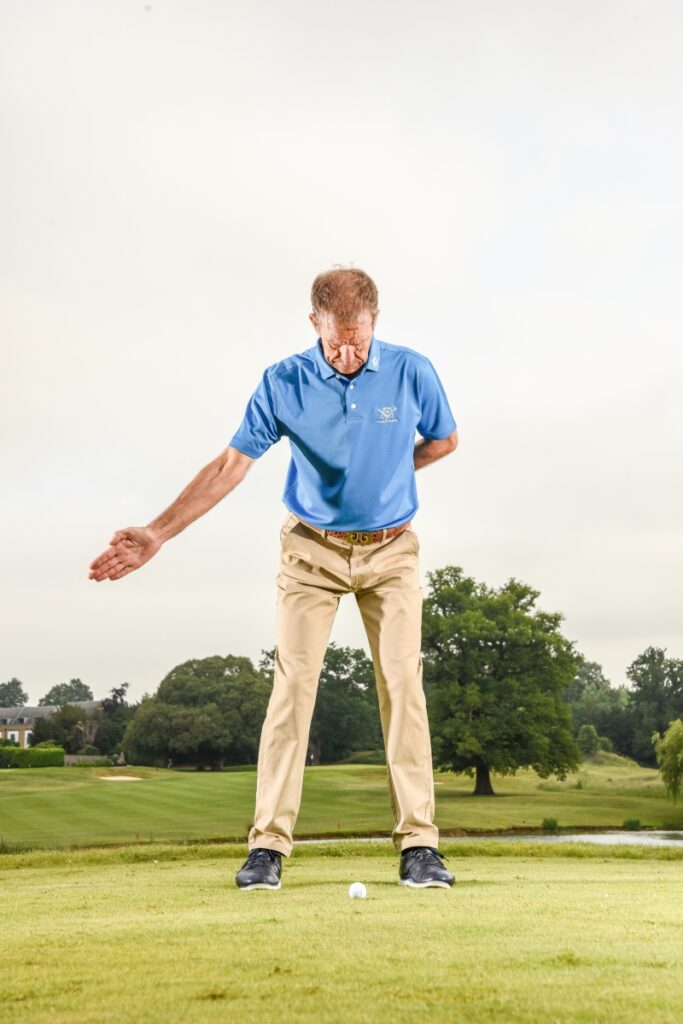
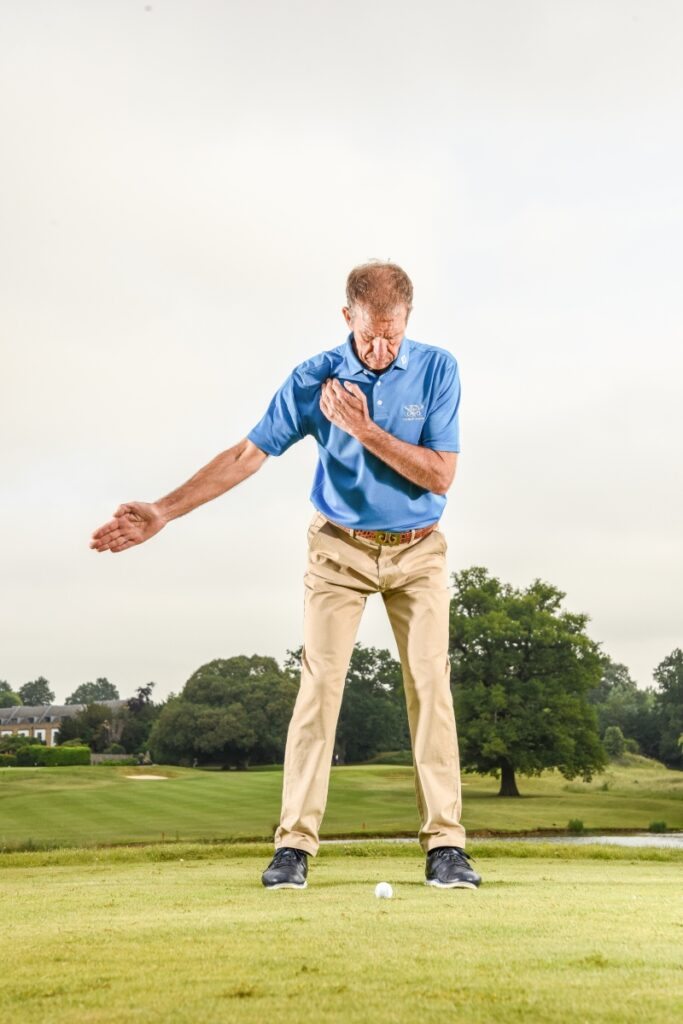
Think about some of the times when you felt tense or nervous on the golf course and you might be able to relate to the feeling of being constricted and moving as a block (see images 1 and 2).

In these images, the tension has stopped my arms from swinging freely – this is what I mean by moving as a block; this ruins the timing of your swing making it difficult to have good rhythm, balance and flow.
The movement practice to reduce this tension is probably not what you are used to hearing but having watched every standard of golfer work through these movements, I can promise you the results can be outstanding, so do not underestimate the simplicity.
With one simple movement practice you will begin to get flow and momentum into your arms’ swing which will improve the timing and balance of your swing, helping you hit the centre of the club face more often, which as we know leads to more power and consistency.
Finding your shoulder joint
In golf we often are told to make a full shoulder turn. What I am going to share with you here is very different. In fact, in image 1 above you might think I have made a full shoulder turn but in fact I have not used my shoulder joint at all, and this is why there is no flow and rhythm to my swing.

So, the first step to improve the timing of your swing is finding your shoulder joint. For now, we are going to specifically focus on your right shoulder joint (left hand golfers, use your left shoulder).
Put your right arm out straight as shown in image 3. Keep your arm straight and begin to swing your arm without your chest following (image 4).
To create the arc, I am demonstrating in images 5 and 6 your shoulder joint will have to externally rotate and then internally rotate. If you do not do this, you will find your chest moving and following too much.

Once you are aware of your shoulder joint moving, to help you create an arm swing you can then gradually build up the arc as shown in images 7 and 8.

Note that as you swing into a bigger arc, your arm will naturally begin to bend at the elbow, however you should still be aware of the shoulder joint working.

The key thing you are looking to be aware of here is a big arc with your arm that creates momentum and flow without the need for your chest to follow too much. You want the feeling of your chest following the momentum of your arm so that you move in a nice sequential movement by using your shoulder joint correctly.
Once you have got the feeling you could then begin some one-arm swings holding the golf club (no need to hit a ball). This will start to give you the feeling of momentum and flow with your arm and club, letting your body respond. Have the feeling that it is your arm swing that moves the body not the other way round. See images 9 to 11:


With a little practice, you can start to swing with both hands, and you should start to feel less tension and better flow and rhythm in your swing, very often noticing your body weight transferring much better, and this will result in far better shots.
Scott Cranfield is a PGA Master Coach helping golfers to move better, and play better in a more natural way. Scott has had success coaching complete beginners through to Ryder Cup players. Readers of Clubhouse Algarve magazine can get FREE access to Scott’s highly acclaimed 21 Day Golf Swing Reset (RRP €499).
Simply email [email protected] and quote “Clubhouse Algarve”.
Read also:
The Old Course Clubhouse hosts two special culinary experiences this October
